
Do lymphatic drainage drops work? What the evidence says
What is in them, what is known about each ingredient, what the risks are and what you can do instead if your face feels puffy or your legs feel heavy. No brands, and every source in view.
8 min read Sources ↓
What is in them
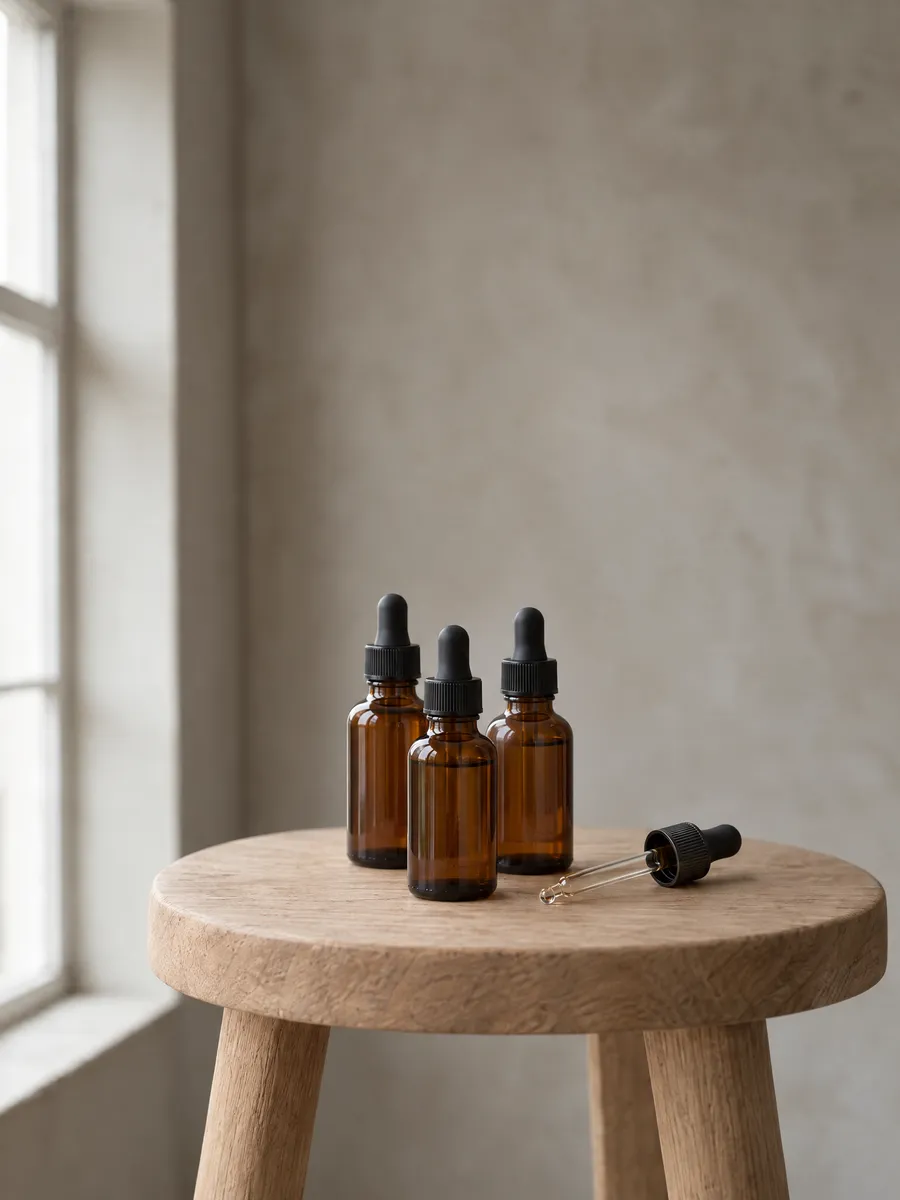
Most are tinctures: plant extracts in glycerin, water or alcohol, taken as drops under the tongue or stirred into water. Some are sold as “liposomal,” a format that promises better absorption. The labels of the best sellers keep coming back to three groups of herbs:
- The so-called “lymphatic herbs.” Cleavers (Galium aparine), red root (Ceanothus americanus), stillingia or queen’s root (Stillingia sylvatica), prickly ash (Zanthoxylum americanum), red clover and calendula. Some formulas add poke root (Phytolacca americana), a toxic plant.1
- Diuretic and “liver” herbs. Dandelion, burdock, milk thistle, artichoke, turmeric and licorice.
- Herbs sold for the immune system. Echinacea, elderberry, astragalus and cat’s claw.
“Lymphatic” oils have taken off too, mostly ginger oil rubbed onto the belly or legs. The promises are much the same from one brand to the next: less puffiness when you wake up, lighter legs, getting rid of excess fluid and “activating” your lymphatic system, often within a week or two.
What we know, and what we do not
We looked up the studies on each ingredient in PubMed and in the fact sheets of the US National Institutes of Health (NIH), Memorial Sloan Kettering Cancer Center and the European Medicines Agency. Here is the summary, claim by claim.
- That they move lymph or “activate” the lymphatic system
- Not studied
- Nobody has measured it. PubMed lists not a single clinical trial of cleavers (Galium aparine), the herb that turns up most often.2 Its reputation as a “lymphatic” herb comes from traditional herbalism, not from studies.
- That they reduce puffiness in the face or legs
- Not studied
- No study has tested this with these drops. And waking up with a slightly puffy face can be normal and, if it settles within a few hours, is usually nothing to worry about,3 so a photo at 8 am and another at 11 can show a change even if you take nothing.
- Dandelion: that it makes you pass more urine
- Weak evidence
- In a pilot study of 17 people, a leaf extract increased how often they urinated after the first dose; by the third dose it made no difference.4 The European Medicines Agency accepts this as a traditional use, based only on its long history.5 Passing more urine is not the same as moving lymph.
- Red clover and burdock
- Not studied
- Red clover has been studied for menopausal hot flashes, with mixed results, but not for lymph.6 For burdock, Memorial Sloan Kettering notes that evidence is lacking even for its diuretic effect.7
- Echinacea
- Not studied
- It is sold for the immune system. It may slightly reduce your chances of catching a cold,8 but no study links it to lymph.
- “Lymphatic” ginger oils
- Not studied
- There are no studies in people: a PubMed search for ginger and lymphatic drainage returns no results.9 What is more, clinical self-massage leaflets ask for bare skin, with no cream or oil.10
- That they flush out toxins or help you lose weight
- No
- A 2015 review found no compelling research to support “detox” diets for eliminating toxins or managing weight.11 No study has tested these drops for either.
- Manual lymphatic drainage, as part of lymphedema treatment
- Evidence
- In women with lymphedema after breast cancer, adding it to compression bandaging gave a further 7.11% reduction in arm volume on top of the 30 to 38.6% achieved by bandaging alone, according to a 2015 Cochrane review.12 The benefit is small, and it is given or taught by a specialist.
In short: nobody has measured what these drops do to lymph, and the little that is known about their herbs concerns other things, such as passing more urine or catching colds. Something not having been studied does not prove it does not work. But it does mean that a specific promise, such as “results in 7 days,” is not backed by any data.
Risks, and who should not take them
Being made from plants does not make them harmless. This is what the fact sheets on their ingredients say:
- Allergies. Echinacea, dandelion, burdock, calendula and milk thistle all belong to the daisy family. Echinacea can cause allergic reactions, sometimes severe,8 and the European monograph on dandelion rules it out if you are allergic to this family.5
- Medicines. Red clover may increase the risk of bleeding if you take blood thinners such as warfarin.6 Dandelion might interact with blood thinners, water pills and diabetes medicines,13 and licorice with corticosteroids.14 If you are having surgery, tell the team you take them: some supplements can cause problems during an operation.15
- Heart, kidneys and blood pressure. In large amounts or over a long time, licorice can cause an irregular heartbeat, and the risk is higher if you have high blood pressure or heart or kidney disease.14 The European monograph advises against dandelion if you have kidney failure, heart failure or diabetes.5
- Liver. The same monograph rules dandelion out if you have liver disease, gallstones or any other gallbladder or bile duct problem.5 And liver damage has been reported with turmeric supplements designed to be better absorbed.16
- Hormone-sensitive cancers. Red clover has estrogen-like activity, and Memorial Sloan Kettering advises avoiding it in these cases.6
- Pregnancy and breastfeeding. They have not been shown to be safe. Red clover6 and dandelion5 are not recommended at this stage, turmeric supplements may be unsafe16 and burdock may stimulate the uterus.7
- Poke root. If the label lists poke root (Phytolacca americana), do not take it: at high doses or with prolonged use it can cause vomiting, bloody diarrhea and convulsions.1
There is a less visible risk too: that drops put off a check-up you needed. Swelling can come from something as ordinary as long hours on your feet or a salty diet, but also from a blood clot, an infection or a heart, kidney or liver problem.17
And if you have lymphedema, or a heart, kidney or liver condition, talk to your healthcare team before taking any supplement.15
Why they went viral
In 2026 lymphatic drainage drops went viral on social media, especially in the US, Mexico and Spain. The appeal is easy to understand: they promise something concrete for very little effort. And there are good reasons why they can seem to work:
- The name. They borrow it from a real clinical technique, manual lymphatic drainage, which does have studies in lymphedema.12 The drops have never been tested for that.
- Before-and-after videos. A face can look a little puffy first thing and settle on its own within a few hours,3 and ankles swell more after long hours standing or sitting, or with a salty diet.17 Any before-and-after picks up those changes, whatever you take.
- Several changes at once. Many videos pair the drops with drinking more water, cutting down on salt, walking or massage, and the drops get the credit.
Being on sale is not the same as being tested, either. In the US, the FDA does not have the authority to approve dietary supplements for safety or effectiveness before they are sold.15 In the EU and the UK, health claims on food have to be authorized, and none of the authorized claims mentions lymph or drainage, either in the EU list19 or in the UK one.20 In the EU, claims about plants have been on hold for more than ten years, awaiting assessment.21
What does have support
What does move lymph does not come in a bottle: it is movement. When your muscles contract, they push lymph along. In a scintigraphy study of eight men, exercise made lymph clear from the thigh muscle three to six times faster than at rest.22
Breathing counts too. Deep breathing with your diaphragm widens the thoracic duct, the main lymph vessel in your chest, and helps lymph flow.23 And if your ankles swell by the end of the day, the NHS suggests walking, raising your legs on cushions and not standing or sitting still for long.17
Gentle lymphatic self-massage, the kind NHS lymphedema services teach,10 is another option. In healthy people there is no evidence of extra benefits,24 so take it for what it is: a comfort routine, for a feeling of lightness and a calm few minutes. You will find it step by step in our lymphatic drainage guide and, for the face, in the facial lymphatic drainage guide.
If you have lymphedema, the path is different: treatment with compression, exercise, skin care and manual drainage, led by a specialist.12 Neither drops nor self-massage can take its place.
Questions
Do they have side effects?
They can, like any product made with active herbs. With echinacea, the most common are digestive symptoms such as nausea or stomach pain, and some people have allergic reactions, which can be severe.8 Depending on the blend, interactions with medicines are possible too. If you notice anything unusual, stop taking them and mention it to your doctor or pharmacist.
Can I take them while pregnant or breastfeeding?
Best not, unless your doctor or midwife says otherwise. They have not been shown to be safe, and several of their herbs, such as red clover, are not recommended at this stage.6 And in pregnancy, sudden swelling of the face, hands or feet can be a sign of preeclampsia and needs checking the same day.18
Do they help you lose weight?
No. No study shows that they do, and a 2015 review found no compelling research for “detox” diets in weight management.11 If one of the herbs makes you pass more urine,4 the weight you lose is water, not fat.
How long do they take to work?
There is no timeline, because no effect has been shown. Promises of results “in 7 days” or “in 20 days” do not come from any trial. If swelling has not improved after a few days, or is getting worse, it is time to see a doctor, not to wait for the next dose.17
Can I take them with my medicines?
Ask your doctor or pharmacist first, and take the label with you. Some of these herbs can interact with blood thinners, water pills, diabetes medicines or corticosteroids: the details, with their sources, are in the risks.
I already take them and they suit me. Should I stop?
That is your call. First read the risks on this page and, if any of them apply to you, talk to your doctor. Bear in mind that any improvement may come from other changes you made at the same time, and that the drops do not replace any treatment.
Sources
- 1.Memorial Sloan Kettering Cancer Center (2021). Pokeweed.
- 2.PubMed. Search for clinical trials of Galium aparine (cleavers): no results. Checked in September 2026.
- 3.Cleveland Clinic (2024). Facial swelling.
- 4.Clare BA, Conroy RS, Spelman K (2009). The diuretic effect in human subjects of an extract of Taraxacum officinale folium over a single day. J Altern Complement Med.
- 5.European Medicines Agency, HMPC (2009). Community herbal monograph on Taraxacum officinale, radix cum herba (dandelion).
- 6.Memorial Sloan Kettering Cancer Center (2022). Red clover.
- 7.Memorial Sloan Kettering Cancer Center (2023). Burdock.
- 8.NCCIH, US National Institutes of Health (2024). Echinacea.
- 9.PubMed. Search for ginger AND lymphatic drainage: no results. Checked in September 2026.
- 10.West Suffolk NHS Foundation Trust (2019). Simple lymphatic drainage for legs.
- 11.NCCIH, US National Institutes of Health (2025). Detoxes and cleanses: what you need to know.
- 12.Ezzo J et al. (2015). Manual lymphatic drainage for lymphedema following breast cancer treatment. Cochrane Database of Systematic Reviews.
- 13.NCCIH, US National Institutes of Health (2024). Dandelion.
- 14.NCCIH, US National Institutes of Health (2025). Licorice root.
- 15.US Food and Drug Administration (2022). FDA 101: dietary supplements.
- 16.NCCIH, US National Institutes of Health (2025). Turmeric.
- 17.NHS (2026). Swollen ankles, feet and legs (oedema).
- 18.NHS (2026). Pre-eclampsia.
- 19.Commission Regulation (EU) No 432/2012, list of permitted health claims. Consolidated text of 20 August 2025.
- 20.Regulation (EU) No 432/2012 as it applies in the UK, annex of permitted health claims. legislation.gov.uk.
- 21.Lenssen KGM, de Boer A (2025). Bridging regulation and practice: CJEU and Dutch case law on botanical health claims. Frontiers in Pharmacology.
- 22.Havas E et al. (1997). Lymph flow dynamics in exercising human skeletal muscle as detected by scintography. J Physiol.
- 23.National Lymphedema Network (2025). Lymphedema diagnosis and treatment: position statement.
- 24.UCLA Health (2026). Lymphatic drainage massage: separating fact from fiction.