
Lymphatic drainage: what it is, what it does and how to do it at home
What it is, what the research really says, and a gentle five-minute routine to do at home. It is self-care, not treatment: if you have lymphedema or lipedema, or have had surgery, follow your healthcare team.
12 min read Sources ↓
What lymphatic drainage is
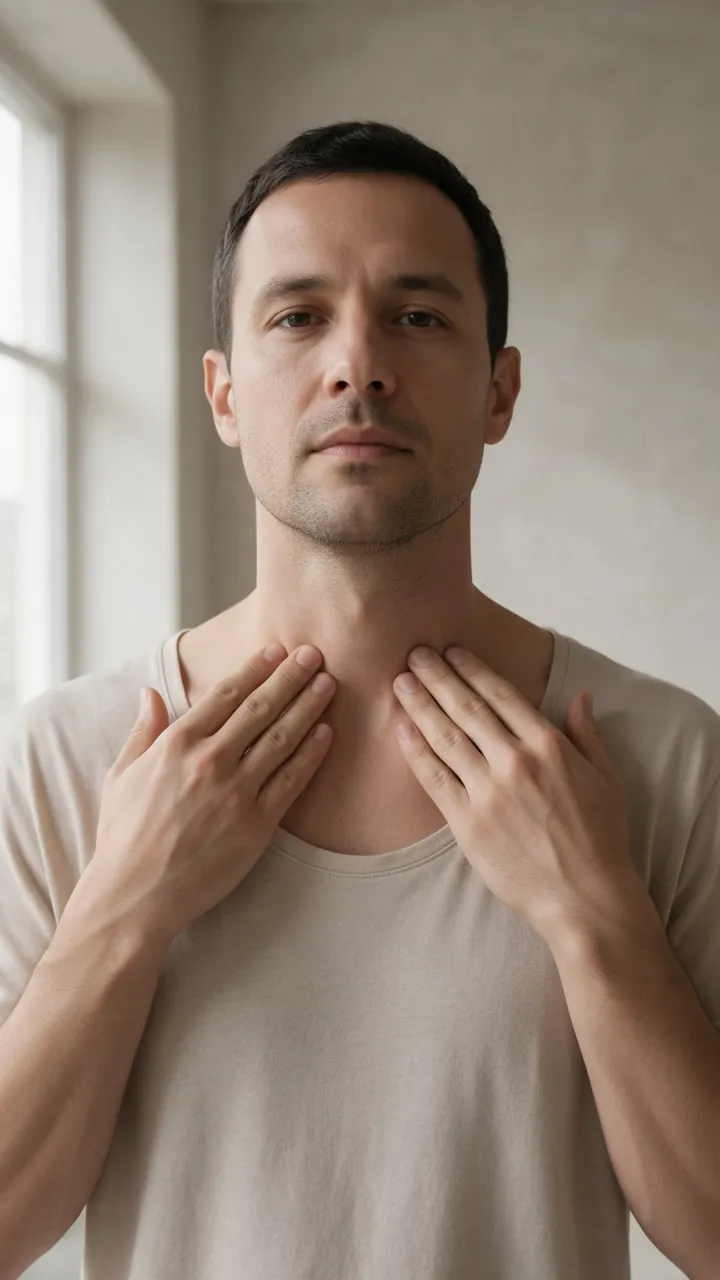
It is a massage that works on the skin, not the muscle. Flat hands slowly stretch the skin as far as it naturally goes and release it,3 always toward the lymph nodes that collect lymph from that area.7 The idea is not to push fluid along, but to go with the route it already takes. You may also see it called lymphatic massage or, after cosmetic surgery, post-op massage.
What the lymphatic system does
Every day, about 20 liters of plasma, the liquid part of your blood, seep out of your capillaries. Most of it goes straight back into your veins, but about 3 liters stay in your tissues, and the lymphatic system collects them.4 That fluid, lymph, travels through vessels with one-way valves, passes through some 600 lymph nodes spread around your body and returns to the blood through two large veins under your collarbones, the subclavian veins.4
Lymph has no heart to pump it. It moves because the vessels themselves contract, 6 to 10 times a minute at rest,5 helped by the pulse of nearby arteries and by your muscles as you move.4 In a study of eight men, contracting the thigh muscles increased lymph drainage from the muscle three- to sixfold.6 Deep breathing helps too, which is why clinical leaflets start their routines with it.7, 3
Manual lymphatic drainage and self-massage are not the same
Manual lymphatic drainage (MLD) is a treatment given by a trained therapist, in sessions of 30 to 60 minutes.8 It has several named schools, such as Vodder, Földi and Casley-Smith,5, 9 and in lymphedema it is one part of a wider treatment with compression, exercise and skin care.1 Imaging studies show it can speed the vessels up to 60 to 100 contractions a minute.5 That is an effect during the session, not proof of long-term benefit.
What you can do at home is something else: simple lymphatic drainage (SLD), a simplified version of MLD designed for people to do on themselves.7 The few studies comparing the two are small and professional MLD comes out ahead, but the British Lymphology Society believes both bring symptom relief and psychological benefit, even though their efficacy remains unproven.7 SLD is what this guide teaches.
What it does: what the research says
It depends on what for, and for whom. A healthy person doing it to feel good is not in the same situation as someone with lymphedema after breast cancer. Here is the summary, goal by goal.
- A feeling of lightness and relaxation in healthy people
- Not studied
- It is what people describe, but there is no evidence of added benefits in healthy people.2
- Lymphedema, as an add-on to compression and exercise
- Weak evidence
- A small benefit on volume, and relief from symptoms such as pain and tightness. Learn it from a specialist.1, 10
- Lipedema
- Weak evidence
- The usual conservative treatment, which includes drainage, brings limited symptom relief.11
- After cosmetic surgery
- Weak evidence
- There are preliminary studies. Only with your surgeon’s go-ahead, because lymph can change its route.2, 12
- “Detox” or flushing out toxins
- No
- A healthy lymphatic system does not need that help, and there is no solid evidence that massage provides it.2
- Getting rid of cellulite
- No
- No treatment removes it, and there is no evidence that massage improves how it looks in the long term.13, 14
In healthy people
If your lymphatic system works well, the honest way to put it is this: lymphatic drainage is a pleasant ritual. Many people describe a feeling of lightness, especially in tired legs or in the face first thing in the morning, and a few calm minutes. These are feelings, and they tend to be temporary. There is no evidence that it brings added benefits to healthy people.2
That does not make it worthless. Five minutes of slow breathing and gentle touch are a good way to switch off, as long as you respect the pressure and the contraindications.
In lymphedema
Lymphedema is long-term swelling that appears when the lymphatic system cannot drain an area properly, often after cancer treatment. There is no cure, but symptoms can usually be controlled with compression, skin care, exercise and specialized massage techniques.15
Within that package, MLD adds little. In the Cochrane review, adding it to compression bandaging reduced excess arm volume by 7.11% more than bandaging alone, which already reduced it by 30% to 39%. That comes from two trials with 83 women treated for breast cancer.1 The International Society of Lymphology’s consensus describes its added value on volume as limited, while acknowledging that it relieves pain and tightness.10 And a Belgian trial with 194 people could not show that adding it to the rest of their treatment improved their lymph vessels.16
If you have lymphedema, learn self-massage from your specialist, who decides the direction and the areas.17 This guide does not replace their advice.
In lipedema and after surgery
Lipedema is a chronic, painful condition of fatty tissue that mainly affects women. Its usual conservative treatment, decongestive therapy, brings limited symptom relief: in a German trial published in The Lancet in 2026, only 8% of the women who stayed on it reduced their leg pain by at least 2 points out of 10 within a year.11
After cosmetic surgery, post-op lymphatic massage is very common, and preliminary studies suggest it may help.2 But it is not something to improvise at home. After a tummy tuck (abdominoplasty), for example, lymph from the lower abdomen stops draining toward the groin and, in 65% of the women studied, starts draining toward the armpits.12 Your surgical team knows which way it should go, so only with their go-ahead.
What it does not do
It does not make you lose weight. There is no evidence that it causes weight loss, and the tighter-looking skin some people notice afterwards is temporary.2
It is not a detox. A healthy lymphatic system does not need help to do its job, and there is no solid evidence that massage “flushes out toxins.”2
It does not get rid of cellulite. No treatment removes it today,13 there is no evidence that massage rollers or devices improve how it looks in the long term,13 and a review of 67 studies found no clear evidence that any treatment works well.14
It does not boost your immune system. It is one of the most repeated promises, and there is no solid scientific evidence behind it.2
What about drops and supplements?
You will find drops, capsules and teas sold as “lymphatic drainage,” but they do not do the same thing: lymphatic drainage is a movement of your hands on your skin, and a healthy lymphatic system does not need help to do its job.2 Before taking any supplement, check with a pharmacist, especially if you take medication or are pregnant. We go into detail in Do lymphatic drainage drops work?
Who should not do it
These are the same four levels Rinpa uses in its safety screening. The lists come from the British Lymphology Society, the US National Lymphedema Network and NHS leaflets.7, 5, 9 The pregnancy rule is our own precaution, stricter than those guidelines.
-
1
See a doctor today, before any self-massage
What these signs describe needs a doctor today, not a massage.
-
2
Wait for the all-clear
If you currently have any of these, do not do lymphatic drainage until your doctor says it is fine.7, 5
- a blood clot (DVT) or pulmonary embolism, now or being treated;
- uncontrolled heart failure;
- kidney failure;
- cirrhosis, especially with fluid in the abdomen;
- uncontrolled high blood pressure;
- superior vena cava obstruction;
- an infection, including a skin infection such as cellulitis or erysipelas.
-
3
Only with the go-ahead
You can do it, but adapted: sometimes the direction changes or some areas are left out. Ask your doctor or specialist first.
- active cancer or cancer treatment: never over the tumor;7
- radiation therapy in the last 6 weeks: leave that area for now;9
- recent surgery, cosmetic surgery included;12
- lymph nodes removed or treated with radiation therapy: the direction changes, and your physical therapist will set it;7
- a poorly controlled thyroid, arrhythmias or other heart problems;7, 2
- a stroke, or being told your carotid arteries are narrowed: no neck work until you have the go-ahead;22
- pregnancy in the first trimester or a high-risk pregnancy; later in pregnancy, no pressure on the abdomen;
- lymphedema or lipedema: learn self-massage from your specialist.17
- 4
Each case is explained, with the reasons, in Lymphatic drainage side effects, and who should not do it.
How to drain your lymphatic system at home, step by step
This is the basic sequence from NHS self-massage leaflets: first you prepare the way out, at the collarbone, neck and armpits, and then you work on the area you are interested in.3, 8 It takes about five minutes. The videos are AI-generated from those leaflets; how we make this content explains how we check them.
Before you start
- Bare, dry skin, no oil or cream: your hand should carry the skin, not slide over it.17, 7
- Flat, relaxed hands, never your fingertips.3
- Minimal pressure. Stretch the skin as far as it naturally goes and release. “If you can feel your muscles underneath your fingers, then you are pressing too hard,” says the West Suffolk leaflet.3 Your skin should not go red.17
- Slowly, with a rhythm.3 We count two seconds to stretch and two to release.
Harder is not better. Overly vigorous massage can damage lymph vessels.10 A study published in Nature in 2025 points the same way, with an important caveat: in mice, very gentle stimulation of the face and neck doubled fluid drainage toward the neck lymph nodes; stronger pressure reduced it.20 We do not yet know whether the same happens in people.
Step 1 · 5 breaths
Belly breathing
Sit or lie down comfortably and rest your hands flat on your belly. Breathe in slowly through your nose, feeling your hands rise, and breathe out even more slowly through your mouth, lips pursed as if blowing out a candle. Leave a short pause between breaths so you do not get dizzy.3
Step 2 · 10 times
Open the collarbone
Place your index and middle fingers, flat, in the hollow just above each collarbone. If you cannot find it, shrug your shoulders for a moment. Stretch the skin down and in, as if drawing a J, and release. Your fingers always stay above the bone.3
Common mistake: rubbing up and down. Your fingers do not slide: they stay on one spot and move the skin with them, about a centimeter, no more.
Step 3 · 10 times
Sides of the neck
Flat hands on the sides of your neck, just below your ears. Stretch the skin back and down, and release. Slowly, keeping a rhythm.3
Step 4 · 10 times
Armpits
Raise one arm slightly and rest it on something, such as a table or the back of a chair. Place the palm of your other hand in your armpit, move the skin up and in, toward your body, and release.3 Finish all ten, then swap sides.
Step 5 · Depends on the area
Your area
Now the area you want to focus on. The rule is always the same: start with the part closest to your trunk and work outward, with each stroke moving the skin toward the nodes you have already prepared.5, 8
Face: it drains toward the neck. It is all step by step in the facial lymphatic drainage guide.
Abdomen and legs: the lower abdomen drains toward the groin,12 and on the legs you start at the groin and continue behind the knee.21 Their guides are coming soon. In the meantime, you can see where each group of nodes is on the lymph node map.
Step 6 · 5 breaths
Finish with breathing
Rest your hands on your belly again and repeat the five slow breaths. Before you get up, notice how your body feels now.
How long and how often
Clinical leaflets ask for it daily, for 10 to 20 minutes.7, 9 Those guidelines are written for people with lymphedema, who do it as part of their treatment. If that is you, your specialist will tell you how often and for how long.8
This routine takes about five minutes. Short routines of 3 to 5 minutes are a simplification we think is reasonable if you do it for wellbeing, but it should be said plainly: nobody has studied whether they give the same result. The repetitions and the rhythm in this guide are our decision, not clinical guidance.
What the leaflets do suggest is fitting it into your day: some people do it in the shower or while watching TV, and others use it as their time to relax.3 Pressure, oil and the other practical questions are in how often to do lymphatic drainage.
Routines by area
Three short routines with every step and its seconds: they open the neck, work one area and close with breathing. Do them as they are, or use them as a starting point. Each has its own guide: the face, heavy legs and the stomach.
Fresh face
5:00- 01 Belly breathing 0:40
- 02 Open the collarbone 0:45
- 03 Sides of the neck 0:25
- 04 Lips to ears 0:25
- 05 Nose to ears 0:45
- 06 Under the eyes 0:45
- 07 Down the neck 0:25
- 08 Belly breathing 0:50
Light legs
8:00- 01 Belly breathing 0:40
- 02 Open the collarbone 0:45
- 03 Armpits 0:45
- 04 Groin march 0:55
- 05 Thigh 0:55
- 06 Behind the knee 1:05
- 07 Calf 0:55
- 08 Ankle pumps 0:45
- 09 Leg sweep 0:35
- 10 Belly breathing 0:40
Calm belly
5:00- 01 Belly breathing 0:40
- 02 Open the collarbone 0:45
- 03 Sides of the neck 0:25
- 04 Armpits 0:45
- 05 Hands-on belly breathing 0:40
- 06 Groin march 0:30
- 07 Lower belly to groin 0:25
- 08 Belly breathing 0:50
Questions
Does lymphatic drainage work?
It depends on what for. As an add-on to lymphedema treatment, there is evidence of a small benefit.1 For lighter-feeling legs or face, or to relax, it works as a ritual, although no studies measure benefits in healthy people.2 For weight loss, “detox” or cellulite, no.2, 13 It is laid out goal by goal in does lymphatic drainage work?
Does lymphatic drainage help you lose weight?
No. There is no evidence that it causes weight loss or fat loss.2 If your skin looks tighter afterwards, that is temporary.
How do I know if I need lymphatic drainage?
If you are well, you do not need it: it is optional self-care. If you have swelling in an arm or leg that does not go away, especially after cancer treatment, do not diagnose yourself: see your doctor, who may refer you to a lymphedema clinic.15 And if the swelling is new, sudden and on one side, get help today.18
Can I do it every day?
Yes. Clinical leaflets suggest doing it daily,7, 3 and with the right pressure it is gentle enough to do every day. There is no need to count sessions per week.
Does it hurt?
It should not. If it hurts, you are pressing too hard or something needs checking, so stop.3 Your skin should not be red afterwards either.17
Can I do it while pregnant?
Ask your midwife or doctor first, especially in the first trimester or if your pregnancy is high-risk. If they give you the go-ahead, do the neck, armpits and face as usual, but the abdomen only with breathing and your hands resting on it, with no pressure. This is our own precaution, not a rule from the leaflets.
Where are the lymphatic drainage points?
They are the groups of lymph nodes you move the skin toward: above the collarbones, in the neck, in the armpits and in the groin,8 and behind the knees.21 They are drawn, area by area, on the lymph node map.
Sources
- 1.Ezzo J. et al. (2015). Manual lymphatic drainage for lymphedema following breast cancer treatment. Cochrane Database of Systematic Reviews.
- 2.UCLA Health (2026). Lymphatic drainage massage: separating fact from fiction.
- 3.West Suffolk NHS Foundation Trust (2020). How to do self-lymphatic massage on your head and neck.
- 4.Cleveland Clinic (2023). Lymphatic system.
- 5.National Lymphedema Network (2025). Lymphedema diagnosis and treatment. Position paper.
- 6.Havas E. et al. (1997). Lymph flow dynamics in exercising human skeletal muscle as detected by scintography. The Journal of Physiology.
- 7.British Lymphology Society (2022). Lymph Facts: self lymphatic drainage.
- 8.Royal Cornwall Hospitals NHS Trust (2025). Manual lymphatic drainage.
- 9.Royal Devon University Healthcare NHS Trust. Head and neck simple lymphatic drainage (SLD).
- 10.International Society of Lymphology (2023). The diagnosis and treatment of peripheral lymphedema: 2023 consensus document. Lymphology.
- 11.Podda M. et al. (2026). Liposuction versus conservative therapy for patients with lipoedema in Germany: a randomised controlled trial. The Lancet.
- 12.Bassalobre M. et al. (2022). Changes in the pattern of superficial lymphatic drainage of the abdomen after abdominoplasty. Plastic and Reconstructive Surgery.
- 13.Cleveland Clinic (2021). Cellulite.
- 14.Luebberding S. et al. (2015). Cellulite: an evidence-based review. American Journal of Clinical Dermatology.
- 15.NHS. Lymphoedema.
- 16.Devoogdt N. et al. (2023). Fluoroscopy-guided manual lymph drainage in breast cancer-related lymphoedema: a randomised controlled trial (EFforT-BCRL). Cancers.
- 17.Macmillan Cancer Support. Lymphatic drainage for lymphoedema.
- 18.NHS (2026). DVT (deep vein thrombosis).
- 19.NHS. Cellulitis.
- 20.Jin H. et al. (2025). Increased CSF drainage by non-invasive manipulation of cervical lymphatics. Nature. Mouse study.
- 21.West Suffolk NHS Foundation Trust (2019). Simple lymphatic drainage: legs.
- 22.Cleveland Clinic (2024). Lymphatic drainage massage.