
Lymphatic drainage for legs: what to do for heavy, swollen legs (and when to see a doctor)
If your legs feel heavy and your ankles swell by the end of the day, it is almost always blood and fluid struggling to flow back after hours of standing, sitting or heat. Here is what you can do today, an 8-minute lymphatic drainage routine and the signs that mean you should see a doctor.
Do it guided now 8 minFree, no sign-up. The gesture on video, the direction drawn over it and the pace, step by step.
7 min read Sources ↓
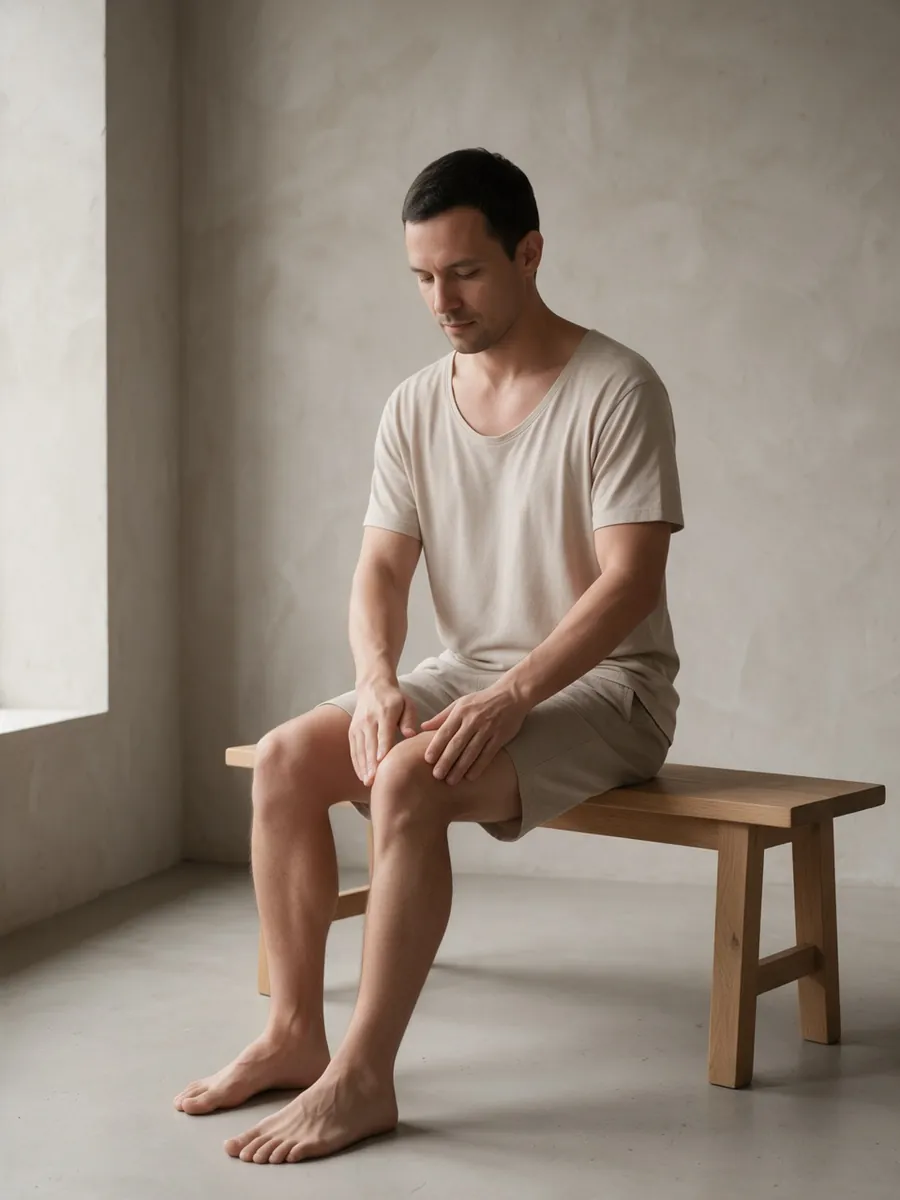
10 steps Breathe · Neck · Armpits · Legs · Move · Legs · Breathe
Why legs get heavy and swollen
The short answer: blood from your legs travels back up to the heart against gravity, pushed mostly by your calf muscles: each time you take a step, the calf squeezes the veins like a pump.1 When you stay still for a long time that push weakens, fluid gathers in the tissues, and the legs feel heavy and the ankles swell, especially after standing a while or at the end of the day.1 It gets worse with heat and better when you lie down, move or cool your legs.6
Chronic venous insufficiency, behind many heavy legs, affects about 1 in 20 adults, mostly over 50.1 Other common reasons for swollen ankles and legs are:2, 3
- standing or sitting for a long time, including long journeys;
- a lot of salty food, and being overweight;
- pregnancy and hormonal changes in the menstrual cycle;
- some medicines, such as certain blood pressure drugs, anti-inflammatories and steroids (do not stop them without talking to your doctor);
- varicose veins and other vein problems.
What you can do today
- Raise your legs whenever you can, ideally above the level of your heart, on a couple of pillows.1, 2
- Walk and move: it is what gets the calf pump going.1, 2 If you sit for work or travel, get up now and then; seated, flex your ankles up and down.
- Avoid tight clothes, socks and shoes, especially around the thighs.2, 3
- Less salt.3
- Compression stockings help; ask a pharmacist or your doctor which ones suit you.1, 3
The 8-minute routine
The simple lymphatic drainage for legs that NHS lymphoedema services teach starts with deep breathing and clearing the tummy and groin before touching the leg; then the leg is worked from the top, always stroking the skin upwards, pressing the back of the knee while it bends and straightens, and finishing with ankle movements.4 Our routine follows that order and adds the neck and armpits at the start: all lymph returns to the blood next to the collarbone, so the end of the path is opened first.5
No cream or oil, no pain and no redness left on the skin.4 Sit on a steady chair with your legs bare. These are the ten steps:
Light legs
8:00- 01 Belly breathing 0:40
- 02 Open the collarbone 0:45
- 03 Armpits 0:45
- 04 Groin march 0:55
- 05 Thigh 0:55
- 06 Behind the knee 1:05
- 07 Calf 0:55
- 08 Ankle pumps 0:45
- 09 Leg sweep 0:35
- 10 Belly breathing 0:40
What to expect: lighter legs afterwards. Moving and breathing deeply help blood and lymph flow back, but in healthy people no study has measured how much self-massage reduces swelling, so we will not promise you a number.7
In hot weather and after a trip
Swollen legs and ankles in hot weather
Heat makes swelling and heaviness worse, and cool water eases them.6 In summer, do the routine in the evening, raise your legs afterwards, and avoid long hours standing in the sun.
After a flight or a long drive
Sitting for hours makes feet and ankles swell.3 On the way, get up and walk when you can, and flex your ankles while seated.3 When you arrive, the routine and your legs up. If after a long journey you notice a warm, red or painful calf, or you are short of breath, it is not for massage: see a doctor or call 911.2
When it is not normal
Questions
How do I reduce swelling in my legs fast?
Lie down with your legs raised above your heart for a few minutes and move your ankles.1, 3 Then the routine. Cool water also eases the heaviness.6
Does lymphatic drainage help heavy legs?
It moves the skin in the direction lymph already flows and combines massage with knee and ankle movement, which is what most helps blood and fluid flow back. The lighter feeling is real; what is missing are trials measuring how much it reduces swelling in healthy people.7
Is it the same as varicose veins?
No, but they are related: heaviness and swelling are often early signs of venous insufficiency, and varicose veins can appear over the years.1 If you already have them, ask your doctor before you start.
How often can I do the routine?
Daily, ideally in the evening or after a day on your feet. It is gentle, unless you have any of the signs above.
Sources
- 1.Cleveland Clinic (2022). Chronic venous insufficiency (CVI).
- 2.NHS (2026). Swollen ankles, feet and legs (oedema).
- 3.MedlinePlus. Foot, leg, and ankle swelling.
- 4.West Suffolk NHS Foundation Trust. Simple lymphatic drainage: legs.
- 5.Cleveland Clinic. Lymphatic system: what it is, function and anatomy.
- 6.Spanish Society of Community Pharmacy (SEFAC). Practical guide to tired legs syndrome (in Spanish).
- 7.UCLA Health (2026). Lymphatic drainage massage: separating fact from fiction.